
July 4, 2026
GospelGuardian Speaks with Sam Shamoun
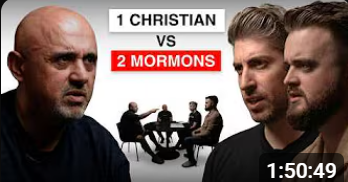
Watch the full discussion here: https://www.youtube.com/watch?v=todYgXYkqxQ&t=6136s
Watch the touching response from Sam Shamoun post-debate: https://www.youtube.com/watch?v=7wEWb0zuhTM
What Happened When Two Latter-day Saints Sat Down With a Christian Apologist to Debate the Godhead
Recently Sam Shamoun, a well-known Christian apologist, and two apologists from The Church of Jesus Christ of Latter-day Saints - Latter-Day Logic and GospelGuardian sat down to hash out one of the oldest and most important theological questions in Christianity: what is the nature of God?
I want to walk you through what happened, what was said well, where the conversation broke down, and what I think it reveals about where we actually stand.
The Setup
Sam came in as a Trinitarian. His background is scripture and church history, not formal philosophy, and to his credit he said so openly. The two Latter-day Saint participants came in with three stated objections to the Trinity: it is not biblical, it is not logical, and the early church fathers did not have a coherent definition of it until the 4th century.
Right out of the gate, that is a bold opening. And honestly, it landed.
Where Things Got Interesting
Sam explained the Trinity using a framework most Trinitarians don't lead with: the monarchia of the Father. The idea that the Father is the source of divinity, the Son is begotten, the Spirit is spirated, and their unity is anchored in the Father as the origin of the one divine essence.
One of the Latter-day Saint participants paused and said something honest and striking. He said that sounded a lot closer to what Latter-day Saints believe than most Trinitarian explanations he had heard.
And he was right. The disagreement is not nearly as wide as most people assume on the question of the Father being the head and source of divine authority. Where it gets genuinely different is on the question of whether the Father has a physical body, whether the three are one being or three distinct beings unified in purpose, and whether creation happened from nothing or from pre-existing eternal matter.
The Ethics Argument
The most philosophically interesting part of the conversation was when one of the Latter-day Saint participants raised what I thought was the most compelling challenge of the night.
If God creates a spirit from nothing, knowing before that spirit is ever born that it will end up in outer darkness, is that a loving God?
Sam pushed back by arguing that the only alternative is God pre-selecting only righteous souls, which eliminates genuine free will entirely. He asked: if God should only create spirits destined for glory, why did he create Adam and Eve knowing they would fall?
The Latter-day Saint response was clear. We do not believe God creates our spirits. We believe intelligences are co-eternal with God. We consented to come to earth. The button, as they put it, does not exist in our theology.
Sam then pointed out that outer darkness in Latter-day Saint theology is still a conscious, permanent state. So the same dilemma he faces, they face too. That moment exposed a genuine tension worth thinking through.
John 4:24 and the Body of the Father
Sam argued from John 4:24 that because God is spirit, the Father cannot have a physical body. One of the Latter-day Saint participants had clearly done his homework. He pointed out that the Greek construction is a qualitative predicate nominative, the same grammatical structure as "God is love" or "God is truth." It describes the nature and character of God, not a statement that God is exclusively and only spirit with no other dimension to his existence.
He also pointed out that Jesus is called a life-giving spirit in 1 Corinthians 15:45 while clearly having a resurrected physical body in the same chapter. Being described as spirit does not rule out a body.
Sam acknowledged the point was fair. And then something important happened. He and the Latter-day Saint participants agreed: the doctrine of the Father having a physical body of flesh and bone is not taught explicitly in scripture. It requires modern revelation to establish it. That honesty from our side was refreshing and exactly right. We do not pretend the Bible alone gets you there. That is what Joseph Smith is for.
John 17 and the Meaning of Oneness
The Latter-day Saint participants used John 17:20-23 well. Jesus prays that his disciples would be one as he and the Father are one. Their argument was simple: no one thinks billions of believers literally merge into a single being, so oneness in John 17 clearly means unity of purpose, mission, and will. If that is what oneness means for us, why must it mean something metaphysically different for the Father and the Son?
Sam's counter was that because God is unlike any creature, the analogy breaks down and cannot be applied identically. He leaned heavily on Nehemiah 9:6 and Isaiah 37:20, emphasizing the word alone. Not just one Yahweh, but Yahweh alone. He argued that if the Father, Son, and Spirit are all Yahweh, and Yahweh is alone, you cannot arrive at three separate beings.
This is where the conversation reached its honest conclusion. The two sides had to agree to disagree. The Latter-day Saint participants interpreted Yahweh as a title shared by the three in perfect unity. Sam interpreted it as the singular personal name of a singular divine being expressed in three persons.
Both sides stayed respectful. Neither side pretended the other had no argument.
Are Mormons Christian?
Sam's answer was more generous than most of his critics would expect. He said he believes there are Latter-day Saints who sincerely love God and follow Christ and who, by God's grace, are saved in spite of theological differences he believes are significant. He drew a distinction between individual members and official institutional doctrine.
On the official doctrine, he said he cannot see how it aligns with historic Christianity, primarily because LDS theology does not hold to the uncreated nature of Father, Son, and Spirit, and does not teach creation ex nihilo. He framed the real crux of the entire debate clearly: everything hinges on whether Joseph Smith is a genuine prophet. If he is, modern revelation resolves what the Bible alone leaves open. If he is not, then LDS theology is a departure.
He was right about that. And I think we should be comfortable saying so.
What I Took From It
This conversation was one of the better faith dialogues I have seen on this topic. Nobody yelled. Nobody was dishonest about what they believed. Nobody pretended their position had no challenges.
A few things stood out to me:
The Latter-day Saint participants were honest about what requires modern revelation and what does not. That intellectual honesty is a strength, not a weakness. The Restored Gospel does not need to pretend everything is in the Bible. It stands on the claim that God still speaks.
The ethics argument was powerful. The idea that consenting intelligences come to earth rather than being conjured into existence by a God who already knows their eternal outcome is a genuinely compelling theological position. It deserves more attention than it typically gets in these conversations.
The John 17 argument was strong. If oneness does not mean one being when applied to believers, the burden of proof is on the Trinitarian to explain why it must mean one being when applied to the Father and the Son.
The Trinity still has not answered the question Jesus himself poses in John 20:17 when he calls the Father his God after the resurrection. That was not raised in this conversation. It should have been.
This is the kind of dialogue we need more of. Respectful, honest, and willing to follow the argument wherever it leads.
Come and see.